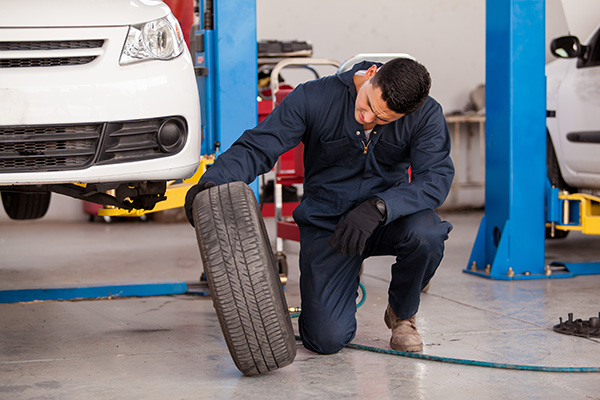
Tire rotation sounds like one of the simplest services on a maintenance schedule, so it is easy to treat it as optional. The tires still have tread, the car drives normally, and no warning light tells you they need to be moved from one position to another.
The problem is that tires don't wear evenly when they stay in the same spot. Steering, braking, vehicle weight, drivetrain layout, and alignment all place different loads on each tire. Rotating them at the right intervals helps spread that wear across the entire set instead of letting two tires wear out long before the others.
Front Tires Usually Work Harder Than Rear Tires
On most passenger vehicles, the front tires handle the steering and a large share of the braking force. Front-wheel-drive vehicles also send engine power through those same tires, adding another job to the list.
That extra workload can wear the front tread noticeably faster than the rear. If you never rotate the tires, you can end up replacing the front pair while the rear tires still have plenty of tread. Moving the tires through the correct rotation pattern gives each one time in different positions and helps the set wear more evenly.
Rotation Helps You Get More Life From the Whole Set
A tire does not have to be completely bald to be finished. Once tread gets too low, wet-road traction drops and the tire becomes less useful even if another tire on the vehicle still looks nearly new.
Regular maintenance through tire rotation helps prevent that large difference in tread depth. Instead of repeatedly buying two tires at a time because one axle wears faster, many drivers can get closer to using the full service life of all four tires together. That also makes future tire replacement easier to plan.
Uneven Tire Wear Can Change How the Car Feels
As tread wear becomes uneven, the car can start feeling different on the road. You might notice more road noise, vibration, reduced wet traction, or steering that does not feel as settled as it once did.
Some tires also develop feathering or cupping when another problem is present. Rotation will not repair an alignment issue or worn suspension component, but it gives us repeated opportunities to see how each tire is wearing. A strange pattern tells us something else is wrong and worth checking before the tire is permanently damaged.
Tire Rotation Gives Us a Chance to Catch Problems Early
One benefit drivers sometimes overlook is what we can see while the wheels are being moved. With the vehicle raised, we have a much better view of the tires, brakes, and several suspension components.
During an inspection, we can spot issues such as:
- Nails or screws in the tread
- Sidewall cuts or cracking
- Uneven tread depth
- Abnormal inside-edge wear
- Cupping or scalloped tread
- Brake wear that needs attention
- Loose or damaged suspension parts
- Signs of a wheel bearing problem
Finding one of these issues before it becomes obvious from the driver's seat can save a tire and sometimes prevent a breakdown.
Rotation Is Especially Important on AWD Vehicles
All-wheel-drive vehicles deserve extra attention to tread depth because their drivetrains depend on all four tires rolling at very similar speeds. A large difference in tire circumference can place unnecessary strain on AWD components.
Rotating the tires helps keep tread depth more consistent from one corner to another. It does not guarantee every tire will wear at the same rate, but it gives the set a much better chance. We also measure tread depth when needed because visual appearance alone does not always reveal a meaningful difference.
Rotation Cannot Fix Alignment or Suspension Problems
If one tire is wearing heavily on the inside edge, simply moving it to another corner does not solve the cause. The vehicle could have an alignment problem, a worn ball joint, a damaged control arm bushing, a weak shock or strut, or another suspension issue.
This is where tire rotation becomes useful as more than a maintenance item. If we see the same abnormal pattern developing repeatedly, we know it is time to look deeper. Correcting the cause protects the remaining tread instead of moving a damaged tire around the vehicle and hoping the wear stops.
The Correct Rotation Pattern Depends on the Vehicle
Not every set of tires should be rotated the same way. Front-wheel drive, rear-wheel drive, all-wheel drive, directional tires, and vehicles with different front and rear tire sizes can require different patterns.
Directional tires generally stay on the same side of the vehicle unless they are removed from the wheels and remounted. Staggered setups with larger rear tires might not be able to rotate front to rear at all. We check the tire type and vehicle configuration before deciding where each wheel belongs.
Do Not Wait Until the Tires Look Uneven
By the time a driver can clearly see that two tires are badly worn, some of the usable tread has already been lost. Rotation works best when it is done before a major difference develops.
A good interval depends on the vehicle, tires, driving conditions, and manufacturer recommendations. For many drivers, pairing tire rotation with another routine service makes it easier to stay consistent. What matters most is monitoring tread depth and wear patterns instead of waiting for the tires to look obviously worn.
Get Tire Rotation Service In Springfield, MO, With Complete Automotive
If your tires have not been rotated recently or you are seeing uneven tread wear, Complete Automotive can check tire condition and rotate them correctly at either of its two Springfield, MO locations.
Schedule your tire rotation before uneven wear costs you usable tread, and follow us on Facebook for shop updates and automotive tips.